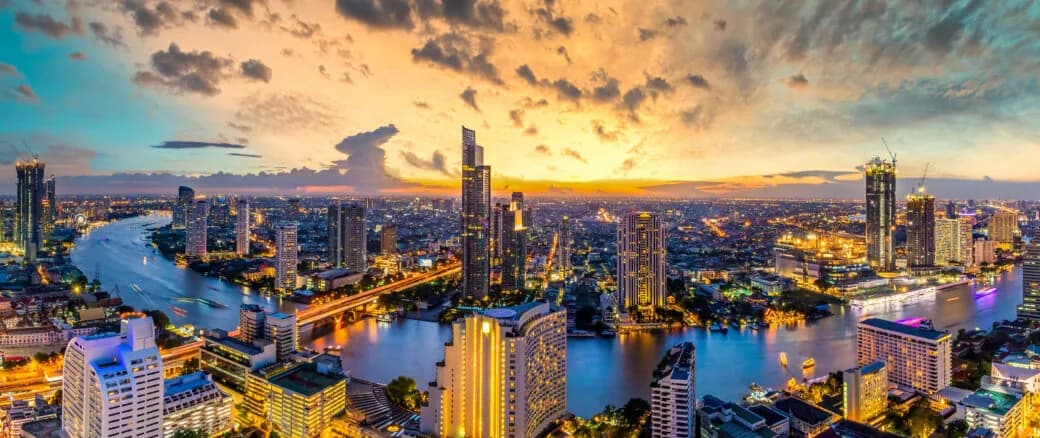
Exploring More Emerging Business Hubs in Asia Pacific
In our latest exploration of Asia-Pacific’s growth cities, we delve into four additional hubs — Bangkok, Shenzhen, Kuala Lumpur and Auckland.
Modern businesses recognise they have a duty to meet and even exceed Environmental, Social and Governance (ESG) goals, in 2024 more than ever. From global multinationals to streamlined single office entities, businesses – just like individuals – must recognise and act upon their responsibilities to contribute to a better future for all. But how do companies successfully align their operations with ESG principles when heavily reliant upon travel, and in particular air travel?
Written by Traveltrust

Scrutiny of corporate travel programs has never been higher and with air travel being such a major contributor to carbon emissions, getting the balance right between managing travel needs and satisfying ESG commitments can be a major pressure point for ESG teams and business travel managers. As much as the post-pandemic era has seen a rise in virtual meetings, business travel remains essential for building relationships and fostering collaboration, so teleconferencing isn’t always an effective substitute. How then, can this headache be handled?

While business travel accounts for only about 12% of global airline passengers, it generates as much as 75% of airline profits (opens in a new tab), according to Investopedia, and this makes it an easy target for climate activists even if the proportion of emissions generated is far greater within the leisure sector. After all, taking aim at corporations flying executives across the globe tends to gain more support than attacking the humble holidaymaker on their way to Spain for the summer!
Of course the per-passenger carbon emissions of the average business traveller tend to be higher, due to invariably taking up more space on a plane (assuming your business travel policy extends to booking business class seats), along with the associated emissions that come from rides to and from the airport if not using public transport. Business travellers taking advantage of Emirates’ chauffeur-drive service, for example, are going to have a far greater net carbon impact than a passenger in economy who has arrived at the airport by train.
These emissions obviously have a tangible impact on the environment. According to the Intergovernmental Panel on Climate Change (IPCC) (opens in a new tab), aviation contributes roughly 2.5% of total human-caused CO2 emissions globally. As the aviation industry continues to grow, these emissions are projected to rise significantly, highlighting the urgent need for businesses to find ways to reduce their travel footprint.

Carbon offsetting, where companies invest in projects that capture or reduce carbon emissions to compensate for their own, has become an increasingly popular strategy in recent years. However, the effectiveness and transparency of offset programs are often debated. A Guardian investigation last year determined that as much as 90% of supposedly certified offsets are actually worthless (opens in a new tab), casting a shadow over the efficacy of such projects. This lack of standardisation and verifiability raises concerns about the true environmental impact of offsetting.
Instead of solely relying on offsets, a more comprehensive approach to sustainable travel is crucial. This involves:

Integrating sustainability into your corporate travel program isn’t just about environmental responsibility; it can also bring tangible business benefits. A 2022 McKinsey & Company study found that companies with strong ESG performance outperform their peers financially (opens in a new tab). Additionally, focusing on sustainable travel can boost employee morale and attract and retain talent in a world where purpose-driven work is increasingly valued.
Here are some inspiring examples of companies committing to sustainability goals:
The mistake many organisations make is throwing money at the problem of trying to meet sustainability and carbon neutral goals, which is why so many carbon offsetting companies with questionable output are now rife. The businesses with a genuine commitment to meet their obligations know that the first step to addressing the issue of companywide carbon output is to truly understand their carbon output.
By having complete visibility on emissions for historic, in progress and future planned corporate travel, businesses can make more informed decisions on how to optimise their output. This is why Traveltrust provide total visibility on the environmental impact of all travel bookings made through our online platform and via our travel management agents, giving you the control over how you choose to deal with this data. And should you wish to offset your emissions, we provide the facility to do so through our trusted offsetting partner Trees4Travel (opens in a new tab) whose work is completely transparent and verified as impactful.
Get in touch with our team if you’d like to know more about how we can support you in meeting your business’ sustainability goals for 2024 and beyond.
Written by Traveltrust. Published .
In our latest exploration of Asia-Pacific’s growth cities, we delve into four additional hubs — Bangkok, Shenzhen, Kuala Lumpur and Auckland.

Find out how we can make your travel simpler, safer and better value. Leave your details and one of our team will be in touch shortly.